
The high point of the trip will be Goyal's meeting with US Trade Representative Robert Lighthizer on November 13, which is expected to see the USTR push India towards lower import duties in a broad range of areas.
'Clearly, Washington has all but given up hope following US Acting Assistant Secretary of State Alice Wells's stormy visit to Colombo last month where she read the riot act to Sri Lankan leaders to sign the pending status of forces agreement allowing American troops to use Sri Lanka as a hub for operations in the Indian Ocean,' points out Ambassador M K Bhadrakumar.

Harris, in a major foreign policy speech as part of her three-day visit to Singapore, said America's vision includes the freedom of navigation which is vital to all.

It was the American Central Intelligence Agency that made India and Pakistan share highly sensitive evidence after the deadly Mumbai terrorist attacks last November, says a report in the Washington Post.

US President Barack Obama's administration has faced extensive criticism for its failure to prosecute bankers criminally for behavior that led to the financial crisis.
Minister for Commerce and Industry Kamal Nath, who arrived in Washington had critical bilateral discussions with senior administration and Congressional leaders on issues related to WTO and bilateral issues.

'This is a historic juncture when the US is in great need of an alliance with India to strengthen its hands in the fierce struggle with China in the Asian theatre,' points out Ambassador M K Bhadrakumar.
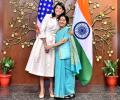
External Affairs Minister Sushma Swaraj and her American counterpart Mike Pompeo have agreed to reschedule the postponed '2+2 dialogue'.
The Chinese side hopes that the next US administration will return to a sensible approach, resume dialogue with China, restore normalcy to the bilateral relations and restart cooperation, Wang, who is also a state councillor, told the state-run Xinhua news agency in an interview.
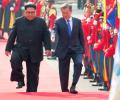
'Much depends on Moon's persuasive skill to make both Trump and Kim shed some of their rigidity and be flexible to accommodate contrarian viewpoints,' says Dr Rajaram Panda.

The state visit of Brazilian President Dilma Rousseff to the US next month has been postponed following the concerns being raised by Brazil with regard to the secretive surveillance programme of NSA as revealed by classified documents leaked by Edward Snowden.
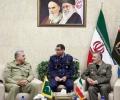
'Tehran senses that the Modi government is inexorably gravitating toward the US-Israeli-Saudi axis, jettisoning India's traditional independent Gulf policies,' notes Ambassador M K Bhadrakumar.
The decision of the US regulator not to allow financial institutions any further increase in their exposure to commodity futures leaves a question mark on the proposal to allow MFs and banks to trade in commodity futures in India. In India if mutual funds, banks, NRI's and Foreign Institutional Investors (FIIs) are allowed there should be limits fixed by the regulator regarding exposure to commodities. The price discovery function can happen only if there is liquidity.

In his address at a ministerial meeting of the SCO in Moscow in the Russian capital, Singh also referred to the Second World War and said its memories teach the globe the 'follies of aggression' of one state upon another that brings 'destruction' to all.

Friday is the last day for White House Chief strategist Steve Bannon, a presidential spokesperson said on Friday.
The heart of the matter is that the Indo-US nuclear deal, unless it is closed now right now and on American terms, will soon need to be harmonised with the new Russian-American format and the international regime emanating out of it
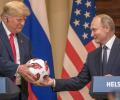
A declassified report by the United States intelligence released stated that Russia and Iran undertook campaigns to influence the 2020 Presidential election, but intelligence agencies found no evidence that foreign actors tried to alter votes or other technical aspects of the voting process.
The US president previously offered to mediate between India and Pakistan, a proposal rejected by New Delhi which maintains that there is no role for any third party in bilateral issues.

The road ahead will be long and winding and much resistance can be expected from the high-flying 'hawks' in our skies. But that should not deter the policymakers from planning a road map with the 'big picture' in mind, observes Ambassador M K Bhadrakumar.
"The recent talk about a new cold war is hyperbolic nonsense. Our relations today are fundamentally different (with Russia) than they were when all we shared was the desire to avoid mutual annihilation," she said, speaking at the World Economic Forum in Davos on Wednesday.
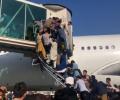
The United States is going to retain a laser focus on its counterterrorism mission in Afghanistan, President Joe Biden said on Friday, and warned the Taliban of a forceful response to any attack on American forces or disruption of its operations at the Kabul airport.

The warning came a day after China cautioned its students against going to the US for studies.

Secretary Tillerson met with Foreign Secretary Jaishankar on Friday to discuss the US-India relationship and the agenda for Prime Minister Modi's meetings at the White House on June 26, a State Department spokesman said told PTI.
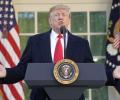
The president, however, implied about declaring a national emergency if the Congress did not approve a funding for the wall by February 15.
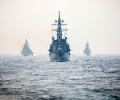
'Any future course of action towards active participation in the alliance when formed would need a lot of deliberation, long term vision and should be in our best national interests,' notes Commodore Vengalil Venugopal (retd).

Narendra Modi will be the first leader to address a joint session of the United States Congress during US House of Representative Speaker Paul Ryan's tenure.

'By treating Nepali politicians as shabby buffoons to be pampered one day and collared another day, India badly exposed itself.' 'A belief got entrenched in the Nepalese mind that we are a dangerous neighbour,' observes Ambassador M K Bhadrakumar.
The Indo-Pak peace process and the war against terror will be high on the talks agenda, said officials.

Trump is demanding China to reduce the $375 billion trade deficit and protection of Intellectual Property Rights, technology transfer and more access to American goods to Chinese markets.

If the Taliban have proved one thing over these two decades, it is that they are way smarter than their big brother, observes Shekhar Gupta.

Modi, in an op-ed published in the Wall Street Journal, wrote that the US and India are forging a deeper and stronger partnership that extends far beyond the Beltway and the Raisina Hill.

'Had a very fruitful meeting with Iranian defence minister Brigadier General Amir Hatami in Tehran. We discussed regional security issues including Afghanistan and the issues of bilateral cooperation,' Singh said in a tweet.

'One must remember that a dragon has a forked tongue,' warns Vivek Gumaste.

The elephant in the room will permeate the conversations, predicts Rup Narayan Das.
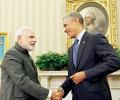
Direct contacts between Obama and Prime Minister Narendra Modi this month helped to end a deadlock that had prevented the WTO from implementing a $1 trillion package of reforms.

The US has been, historically, a sleeping partner in India-China relations. Today, any attempt by the Modi government to make a bilateral move to improve relations with Beijing could upset Biden's apple cart, notes Ambassador M K Bhadrakumar.

During the meeting, Obama expressed appreciation for Saudi Arabia's contributions to the campaign against ISIL, the White House said in a readout of the meeting.

Highlighting that India's strong economy with a growth rate of 7.6 per cent per annum is creating 'new opportunities for mutual prosperity', Modi said transformative American technologies in India and growing investment by Indian companies in the US both have a positive impact on the lives of citizens of both countries.
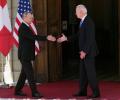
The summit probably fulfilled the expectations on both sides, but the bar of expectations was intentionally kept low, observes Ambassador M K Bhadrakumar.

The US election campaign has provided plenty of ammunition for the CCP to make its case that its political system is superior.
